Betting tax in Kenya 2026: excise duty, withholding tax and the 20% on winnings
 By the Kenya Bet Scout teamTerms checked18+ · we may earn a commission
Every deposit loses 5% to excise duty and every payout loses 5% to withholding tax, stake included. The 20% tax on winnings is back in the law, though the Act ties it to lotteries and prize competitions rather than sports bets. This guide works through what that means for real bets, in shillings.
What taxes do Kenyan punters pay in 2026?
Two charges apply to every Kenyan punter. The bookmaker takes 5% excise duty from each deposit before the money reaches the betting balance, and it takes another 5% in withholding tax from each payout. The Finance Act 2026, in force since 1 July 2026, kept both rates where they were but changed what they are charged on, and that change matters more than most coverage of the Act suggests.
There is also a third charge, a 20% withholding tax on winnings, which the Act applies to pay-outs “from a lottery or prize competition”. Whether that ever reaches an ordinary football bet is a fair question, and it is covered further down. The calculator below shows all three charges on any amount.
Excise duty on deposits
Every deposit for betting. KSh 100 sent leaves KSh 95 to bet.
Withholding tax on withdrawals
Taken when money is paid to your M-Pesa. KSh 1,000 withdrawn arrives as KSh 950.
Withholding tax on winnings
The Act names lotteries and prize competitions. Whether it covers sports bets and jackpots is contested, so we show it as a separate case.
Deposit
What actually lands in your betting account.
Withdrawal
What reaches your phone.
How much tax is deducted from a betting deposit?
Excise duty takes 5% of every deposit, so KSh 100 sent by M-Pesa leaves KSh 95 to bet with. The bookmaker deducts it on arrival and pays it over to KRA, and the punter never sees a separate charge, only a balance that is a little smaller than the M-Pesa message said.
Because M-Pesa only moves whole shillings, round balances need slightly awkward amounts. A punter who wants exactly KSh 1,000 to bet has to send KSh 1,053, which leaves KSh 1,000.35 after excise. A KSh 99 jackpot ticket needs KSh 105.
| To have this to bet | Send this by M-Pesa | Excise taken |
|---|---|---|
| KSh 49 | KSh 52 | KSh 2.60 |
| KSh 99 | KSh 105 | KSh 5.25 |
| KSh 500 | KSh 527 | KSh 26.35 |
| KSh 1,000 | KSh 1,053 | KSh 52.65 |
| KSh 5,000 | KSh 5,264 | KSh 263.20 |
Does it matter how the money is sent?
It does not. The 2026 Act charges excise on the “amount deposited”, which it defines as any money or money’s worth “paid, transferred, credited, or otherwise made available for betting or gambling purposes” to a licensed operator. An Airtel Money deposit, a card payment and a top-up at a betting shop counter are all taxed at the same 5% as an M-Pesa paybill payment.
How much tax is deducted from betting winnings?
A winning sports bet loses 5% of its payout to withholding tax. The important detail is that the 5% is worked out on the whole amount paid out, and that amount includes the punter’s own stake coming back. The table follows one KSh 1,000 bet from the M-Pesa deposit to the final payout, at two different prices.
| Odds 1.20 | Odds 3.00 | |
|---|---|---|
| Sent by M-Pesa | KSh 1,053 | KSh 1,053 |
| Paid out by the bookmaker | KSh 1,200 | KSh 3,000 |
| 5% withholding tax | KSh 60 | KSh 150 |
| Reaches the punter | KSh 1,140 | KSh 2,850 |
| Real profit | KSh 87 | KSh 1,797 |
| Share of the bet’s profit lost to tax | 56% | 10% |
The stake and the tax rates are identical in both columns, yet the bet at 1.20 loses more than half its profit to tax while the bet at 3.00 loses a tenth.
Why short odds pay the most tax
A winning bet at 1.20 pays tax on KSh 1,200 in order to make KSh 200, even though KSh 1,000 of that money belonged to the punter before the match started. When the deposit charge and the payout charge are taken together, the break-even price works out at 1.11. Any bet that wins at odds of 1.10 or lower leaves the punter with less than was sent from M-Pesa in the first place, even though the bet itself was a winner.
This falls hardest on one of the most familiar habits in Kenyan betting: the “safe” multi built from heavy favourites at 1.10 to 1.30 each, or the single on a banker team. Those bets never paid much, and after tax a good number of them lose money even when they come in. For anyone whose betting is mostly small wins at short prices, the 5% payout tax is the largest cost they face.
Long-odds multis and jackpot-style slips
At the other end, a ten-leg multi with a KSh 50 stake at total odds of 120 pays KSh 6,000 if every leg wins. The 5% takes KSh 300 and KSh 5,700 reaches the punter. Tax barely dents a long-odds win in percentage terms. The cost of that slip lies in how rarely ten legs all come in, which the multi-bet guide covers.
When is the 5% withholding tax deducted?
Until June 2026, the 5% was charged when a punter withdrew money from the betting wallet. Anyone who kept rolling winnings into the next bet could put off paying it for as long as the money stayed in the account.
The Finance Act 2026 rewrote that definition. A withdrawal now means any money “paid or disbursed to the account of a player” by a licensed operator. EY’s analysis of the Act reads this as closing the re-betting gap, so the tax falls due when a payout is credited to the account, whether or not the punter ever moves it to M-Pesa.
What that means for rolling winnings over
If bookmakers apply the rule that way, rolling winnings over becomes more expensive than it used to be. A KSh 2,000 win loses KSh 100 when it is credited. If the remaining KSh 1,900 then goes on a bet at 2.00 and wins, the KSh 3,800 credit loses another KSh 190. Under the old rule, the punter would have paid tax once, on whatever was finally withdrawn.
The gap compounds. Every extra winning bet the money passes through keeps only 95% of what the old rule would have left, so after ten winning bets the punter keeps 63% of the old figure, and after fifteen, less than half. That is the cost of the new tax point for anyone who treats a betting balance as a running bank.
What that means for Aviator and other crash games
Crash games settle every few seconds, so the tax point matters even more there. If the 5% is applied each time a cash-out is credited, a player who stakes KSh 10 a round for 100 rounds and cashes out at 1.50x in 60 of them is credited KSh 900 in total and loses KSh 45 of it to tax, on top of whatever the game itself keeps. The Aviator guide explains why the game’s own margin is the bigger problem.
None of the bookmakers whose pages Kenya Bet Scout has read says which way it applies the new rule. The section on checking deductions, below, shows how a punter can see it for their own account.
Is the 20% tax on betting winnings back?
The Finance Act 2025 removed the old 20% withholding tax on winnings. The Finance Act 2026, published in Kenya Gazette Supplement No. 157 and assented to on 23 June 2026, brought it back at 20% for both residents and non-residents, along with a new definition. Winnings now means “a pay-out from a lottery or prize competition by a person licensed under the Gambling Control Act, 2025”.
That definition names lotteries and prize competitions. It does not mention sports betting, casino games or Aviator. The law firm ALN reads it the same way, placing betting and gaming payouts under the 5% withdrawal tax and leaving the 20% for lotteries and prize competitions. Several news reports in July told readers that the 20% now applies to every betting win, but the text of the Act does not support that.
Is there tax on jackpot winnings in Kenya?
The football jackpot is the genuine grey area. Products such as SportPesa’s Mega Jackpot Pro and Betika’s Must Be Won are sold as bets by licensed bookmakers, which on a plain reading puts them under the 5%. A jackpot does resemble a lottery, though, and KRA has not published guidance either way. On a KSh 1,000,000 payout the difference is considerable: KSh 950,000 at 5% against KSh 800,000 at 20%.
Until KRA settles the point, Kenya Bet Scout treats 5% as the rate on sports bets and jackpots and shows the 20% only as a separate “if it applies” case. It never feeds into a bookmaker’s score. Ticket prices and the number of games for each jackpot are on the jackpots page.
How Kenya’s betting tax has changed
Much of the confusion about betting tax comes from how often the rules have moved. Terms pages, old news stories and forum answers written under one regime are still being read under the next, so it helps to see the three most recent sets of rules side by side.
| Period | Money going in | Money coming out |
|---|---|---|
| Until 30 June 2025 | 15% excise duty on every stake placed | 20% withholding tax on winnings, first brought in by the Tax Laws (Amendment) Act 2018 |
| 1 July 2025 to 30 June 2026 (Finance Act 2025) | 5% excise duty on money deposited into the betting wallet | 20% on winnings removed. 5% withholding tax on money withdrawn from the wallet |
| From 1 July 2026 (Finance Act 2026) | 5% excise duty on any amount deposited for betting, including credit from the operator. Horse racing no longer exempt | 5% on money paid to the player’s account. 20% on pay-outs from lotteries and prize competitions |
The move from taxing stakes to taxing deposits made a large difference to regular punters. Under the old rule, a punter who recycled the same KSh 1,000 through ten bets in a week paid 15% excise on each of those stakes. Under the current rule, the same KSh 1,000 pays excise once, when it is deposited. On the way out, the 20% on winnings gave way to a smaller 5% that applies to everything paid out, stake included, which is gentler on long odds and harsher on short ones.
What do bookmakers’ own terms say about tax?
Bookmakers deduct these taxes and pay them over to KRA, so what their own pages say about tax carries weight with punters. Several of them have not caught up with two Finance Acts in a row.
| Bookmaker | What its own pages say |
|---|---|
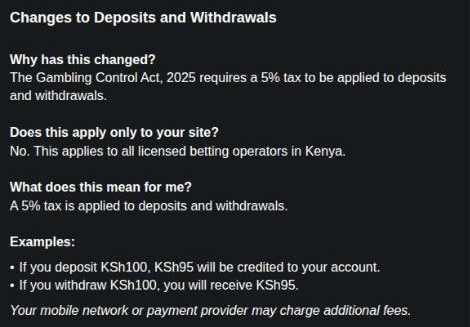
| betPawa | A 5% tax applies to deposits and withdrawals. KSh 100 deposited credits KSh 95. |
| SportyBet | 5% on all deposits and 5% on all withdrawals. |
| Radabet | No rate in its help pages. The site’s own settings use 5% on deposits and 5% on withdrawals. |
| SportPesa | Its how-to-play page still describes 20% withholding tax on net winnings, and its example SMS shows excise taken from the stake at the old 7.5% rate (KSh 6.97 on a KSh 100 bet). |
| OdiBets | Its terms still state 20% withholding tax on winnings. |
| Betika | Taxes are deducted before payment. No rates given. |
| Mozzart Bet, 22Bet | No tax rates stated. |
| ChezaCash (not ranked) | Its FAQ still quotes 7.5% excise on the stake and 20% on winnings minus the stake, both from rules that no longer apply. |







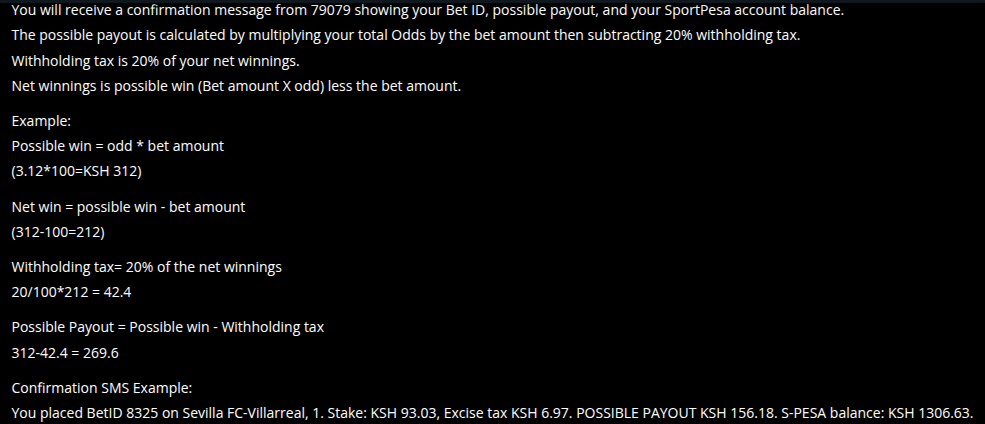
Read on each bookmaker’s own pages on 30 October 2026 (SportPesa on 4 November 2026). Out-of-date wording on a terms page does not mean the old rate is being charged, but it does mean the terms page is not a reliable guide to tax.
How to check what tax was deducted
The only reliable record of what was taken is the punter’s own, and it takes two minutes to read. On the deposit side, the M-Pesa confirmation message shows the amount sent, and the betting balance should rise by 95% of it. A KSh 500 deposit that adds anything other than KSh 475 to the balance is worth asking the bookmaker about.
On the payout side, the transaction history in the betting account lists each credit and each deduction. Comparing a settled bet’s payout with the amount actually credited shows whether the 5% was taken when the bet settled or only later, when the money went to M-Pesa. A punter who keeps a screenshot of both has everything needed for a complaint to the bookmaker, and if that fails, to the Gambling Regulatory Authority.
Is tax charged on bonuses and free bets?
Excise duty used to be charged on money “deposited into a customer’s betting wallet”. The 2026 Act widened that to any money or money’s worth “made available for betting or gambling purposes”, whether it is “provided by a player or the operator”, and whether it is held as cash, credits, tickets or tokens.
Read plainly, that wording reaches the free bets and bonus credit a bookmaker hands out. No bookmaker whose pages Kenya Bet Scout has read has said whether it will absorb that cost or pass it on, either by trimming its offers or by shaving the bonus itself. A bonus that arrives smaller than its terms promised may well be the first sign of this. Winnings from a free bet are paid out like any other winnings, so the 5% applies to them in the usual way. The offers page sets out each bookmaker’s terms.
Betting tax FAQ
Why did KSh 95 arrive when I deposited KSh 100?
That is the 5% excise duty on betting deposits, which the bookmaker deducts before crediting the balance. A punter who wants a round KSh 100 to bet needs to send KSh 106.
Is the 20% tax on winnings back in Kenya?
Yes, from 1 July 2026, but the Finance Act 2026 defines winnings as a pay-out from a lottery or prize competition. Sports bets are taxed at 5% on the payout. KRA has not yet said whether football jackpots count as lotteries.
Is the 5% taken from my stake as well as my profit?
Yes. It is charged on the whole amount paid out, stake included, which is why a bet at very short odds can win and still leave the punter behind once tax is taken.
What odds do I need to make a profit after tax?
Anything above about 1.11. Below that, the 5% on the deposit and the 5% on the payout together take more than the bet wins, so a winning bet still returns less than was sent from M-Pesa.
How much tax is taken from a jackpot win?
On the most natural reading of the Act, 5% of the payout, so a KSh 1,000,000 prize pays KSh 950,000. If KRA were to rule that jackpots are lotteries, the rate would be 20%, leaving KSh 800,000. Either way, the bookmaker deducts it before paying out.
Is betting tax the same for Airtel Money deposits?
Yes. The Act taxes any amount deposited for betting, however it is sent, so Airtel Money, cards and M-Pesa all lose the same 5%.
Do I need to declare betting winnings to KRA?
Under the earlier rules, KRA said the tax a bookmaker withholds is final and that winnings did not need to go into the annual income tax return. KRA has not restated that position for the 2025 and 2026 rules, so it is worth confirming with KRA or a tax adviser before filing a return that includes large wins.
Does a jackpot ticket cost more because of tax?
It does. A KSh 99 ticket needs KSh 105 sent by M-Pesa to cover the 5% excise, and a KSh 49 ticket needs KSh 52.